The movies tend to gift us with perfect topics for fun blogs, don’t they?
Yesterday, my spouse and I saw the Shudder original film, In a Violent Nature, and many of the people in the theater with us did not like it. And ten minutes in, I *knew* that would be the case.
And I loved it anyway.
In the first few minutes of In a Violent Nature, it’s so obviously arthouse-y. It is making its choices not based on entertainment value, but on narrative theme. If you need a little more context, let’s set the scene. The movie opens on a little, broken firehouse slowly being reclaimed by nature. The boards are broken, the glass is dull, the ground is covered in scattered leaves. We move into the now dilapidated shed and find a metal tube in the dirt with a locket hanging on it. Meanwhile, some college-age campers are traipsing around the woods, talking up scary stories of massacres in this area. Despite all the talk of death and violence, one of them walks into the structure and whimsically takes the locket.
Then the earth breathes.
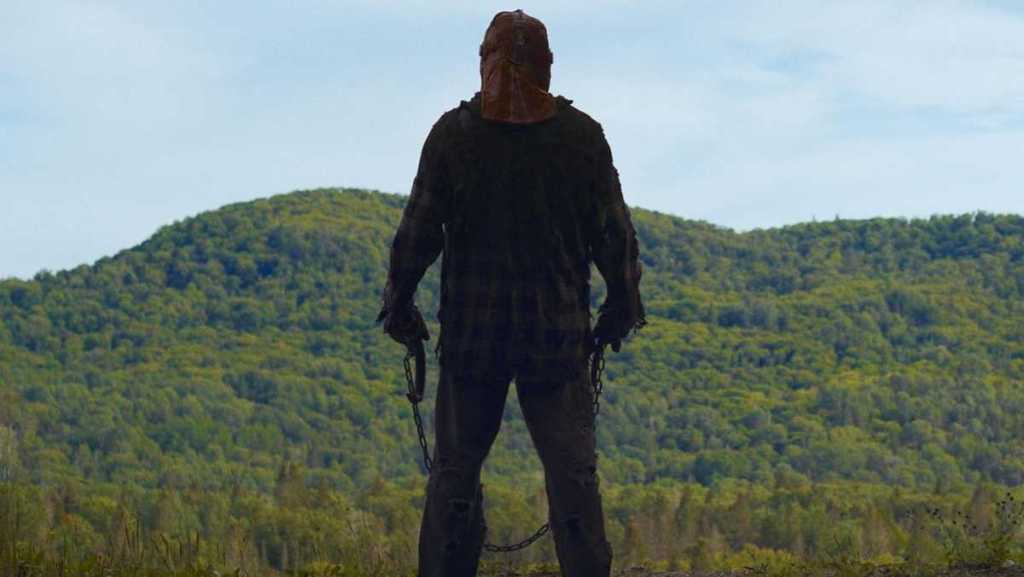
I clocked very early on (as I’m sure most people will, I’m not special) that our rising killer is a metaphor for nature itself. The next ten minutes alone could be a very effective short film. The killer walks through his woods, peacefully, silently, until he stumbles upon an animal killed by a snap trap around his ankle. The killer sees a couple more as he goes, as well as neon ties on trees to be cut down. Walking out of the woods, he happens upon the house of the man who set them. He spooks the man, and the man runs off into the woods, only to be caught in his own, man-made trap. The killer walks up to him and, very nonchalantly and without fanfare, kills him.
So we set the tone. Our killer is nature, and what you do to harm or disrupt nature, nature will do unto you. We humans live under this assumption that we can take and take from nature because it won’t fight back. But what if it did. A simple and effective short film, right?
Then the movie keeps going. We still have thieving campers to deal with.
After that, the purpose of the film gets a little murkier for first time watchers. The killer finds his campers, but takes his time. Doesn’t kill the thief first. Kills the friend who told the story of the killer, supposedly a disabled kid named Johnny who was bullied and eventually killed by fellow locals. Then, his spirt rose up for vengeance. Remind you, this is the story *they* tell about Johnny. The only story that we as watchers have heard from Johnny is that his mother’s necklace is important to him.
And, as we know, they stole that.
So, the killer begins to take out the campers one by one. Slicing the storyteller’s mouth open. Drowning a smoker swimming in the lake. Bending an influencer in half. I need a second watch through to understand the meaning of each death in better depth, because this movie may be slow, but it makes deliberate choices with each characterization and shot. These are all the typical slasher characters and tropes you expect, but from the killer’s perspective, we don’t see *just* goof and gore. We also see him, walking calmly through the woods. Where he belongs. How he may be violent, but among nature he’s at peace. It’s humanity that warps him into something different. That compels him to cause hurt.
As the movie reaches its third act and brings in the ranger to the story, you reach the movie’s thesis. Or, the anti-thesis. Because the human characters of this story try to tell you that the thesis is that sometimes nature is cruel and violent without reason, and you have to take it out or be taken out. You get a story from the ranger about how Johnny has appeared several times before, always mentioning the horror in his wake, but brushing over the fact he only ever rose because someone took his mother’s necklace. When the female main character, the final girl, tries to offer just giving the necklace back, the ranger insists that won’t stop him. It’s too late. That he’s hunting and he won’t stop until they’re all dead. But there’s no proof of that.
And when the killer kills the ranger, he does so brutally—more brutally than anyone else, by cracking his spine to paralyze him, then chopping off his hand before chopping off his head. My spouse and I debated if this was simple revenge, a mimicking of what the ranger did to him last time around, or a particular frustration as a force of nature for the fact some rangers seem little more than prison wardens versus protectors.
Against the ranger’s words, though, the final girl ends up placing the locket on a gas cannister and, while her friend foolishly sacrifices himself for her, she runs off into the words to be—amusingly—bear trapped by a stick of wood. Full circle, eh?
The last twenty minutes of film are suspenseful, tense, and unrelenting. And most of it is spent in a car, having a conversation with a motherly figure. Our Final Girl finds a woman driving down the road, who picks her up and promises to drive her to the hospital. Along the way, she tells this story of her brother, who was attacked by a bear and barely survived. She talks about how the bear had been killing deer in an area, but not eating them. That her brother was told to go after the bear, then it attacked him in a way that bears kill: attacking the head, biting into it. But when her brother half-drowned, it left.
Her whole thesis was that sometimes nature is violent. Unpredictable.
Let’s look into something the woman described during her story: the henhouse effect. This is a phenomenon noticed particularly in foxes when they attack a full coop. They intend to only go in and eat and kill 1-2 chickens, but with all the activity and squawking, they typically ending up killing the whole coop, leaving a dozen hen carcasses uneaten. She attributes this to the madness. Animals can be violent.
But what she doesn’t say, and what’s important to the story, is *why* the henhouse effect exists. Because in the wild, this doesn’t happen. It’s only because humans have penned these animals that the foxes, when they do their natural instinct of hunting, they end up in situations where they get so excited and agitated that they clear the room instead of just taking what they need and going.
Similarly, that implies that (in her story of her brother and the bear) that reason the deer were crowding and agitating the bear was likely because of human activity decreasing their habitat, giving them less land to live in and roam. This means they’ll be more of them running around on top of each other. The bear responds as they know how: to clear our the agitation. That’s far more deer than it can eat. And when it attacks her brother, it isn’t because it was “satisfied with the kill” or pleased by his death. Its because the agitation stopped.
And though she offered Johnny the killer the locket, the final girl is horrified, terrified, that when they stop to wrap up her wound he’ll appear again. For a tense minute she stares out into the woods, waiting.
But he never comes.
In the final moments of the film, the movie disproves all its character’s rhetoric about Johnny being an animal with no logic. Because it pans back to that gas cannister, and shows he took the locket and left.
His habitat was free, and he had what he needed. He could finally return to peace.
Not only does this prove that Johnny did have logic to him—he just wanted his locket—but also their perception that he is a mindless killing animal is all because they refuse to see how simple and easy his logic is. They just refuse to see it from his perspective, from an animal’s perspective. They cannot fathom that all they need to do is give back what’s his and leave. Stop the agitation. Free him.
It also feels like there’s a commentary in here, with Johnny being a disabled kid-turned-immortal-killing-force-of-nature, of people treating a disabled child/adult more like an animal than they do a human. He was a little boy shirked by the world, more comfortable in nature, who keeps being disturbed. And the stories other people tell about his horrible violent nature, when he just needs people to stop disturbing him because they feel like they are human and deserve to take and trespass as they wish. They litter, they smoke, they steal, they harm. And if they only respected him as an equal with rights and property, none of this would have ever happened.
However, that’s a hard narrative to sell when so much of our civilizations have been built on not only taking from nature, but also disregarding disabled people. Disregarding perspectives different than their own.
And this movie was entirely made from a perspective we’re not used to as horror watchers, and unless you buy into it, its hard for people to accept that. Even if it says a lot of thoughtful, interesting things.
Fuck do I need to watch this movie again.
In other news, for Pride Month my book, Daughter of Or is free for the weekend! (June 7th-June 10th). So, if you like horror with a lil nuance, I love that kinda shit! Not to this level, I’m too committed to long glances and monster design and action scenes, but still a blast.
 Steph Roehler
Leave a comment